Blog #1
During the first session, we read about eMarketing Strategies, Search Engine Marketing, and Pay-Per-Click (PPC) Advertising.
Concept 1 - Challenges to the 4 P's
The increasing
transition toward the internet has driven change from the traditional 4 P’s of
marketing to new theories by Seth Godin and Idris Mootee. The traditional 4 P’s of marketing were
developed by E J McCarthy; products and services, price, placement or
distribution, and promotion. Mootee and
Godin have embraced customer-centric marketing; understanding consumer needs,
and from there carrying out their business objectives. Seth Godin believes marketing is formed from
5 elements; 1) data is the information gathered about the consumer, 2) stories
are everything consumers say and do, 3) products, at https://www.openforum.com/articles/seth-godins-9-tips-on-creating-a-remarkable-product/,
Godin provides 9 tips for creating a remarkable product using a
consumer-centric approach, 4) interactions are how marketers begin a
relationship, and 5) connection is the relationship itself. Idris Mootee proposed the new P’s of
Marketing; personalization, participation, peer-to-peer communities, and
predictive modeling. These challenges are
a result of the internet and eMarketing strategies. It is important for marketers to recognize
transition toward eMarketing, but most organizations need to have an offline
marketing strategy that is aligned with their online strategy.
Concept 2 - PPC Advertising
Another crucial concept that will be utilized in the Google
Online Marketing Challenge (GOMC) is PPC discussed in Chapter 7. In a PPC advertising campaign, advertisers can
define keywords that when searched that will appear with other
advertisements. Selecting these AdWords
through Google can fall into a broad match, phrase match, exact match, negative
match, or any combination. When
monitoring results, click-through rates (CTR) needs to be monitored along with
conversion rates. In my opinion, the
most important task in a PPC campaign is to constantly monitor the results and
be flexible. After all, every marketing
plan has key goals and is trying to achieve the highest return on investment
(ROI); this is ultimately how you measure your success and make changes where
necessary. PPC advertising can increase
traffic to your website and is easily traced through real time data; but there
are flaws in the system. Advertisers
need to beware of 1) click fraud, when competitors understand that each click
need to be paid for, 2) bidding war, when an organization focuses on specific
keywords, disregarding the ROI, and 3) the time required to analyze and modify
strategy.
Skill - Overall Utilization of eMarketing
The most important skillset developed comes from the chapter
19 case study on Barack Obama’s strategic use of the internet. This case incorporates so many different components
of eMarketing. The strategy illustrated
is brilliant! The younger generation has
been the hardest group to reach in the past by any presidential candidate; because
of this, Barack Obama made the younger generate his target market. How do you reach the younger generation? Social media!
The Obama campaign utilized Facebook, Twitter, YouTube, Flickr, and www.my.barackobama.com. This website utilized both Godin and Mootee’s
marketing elements through the links below.
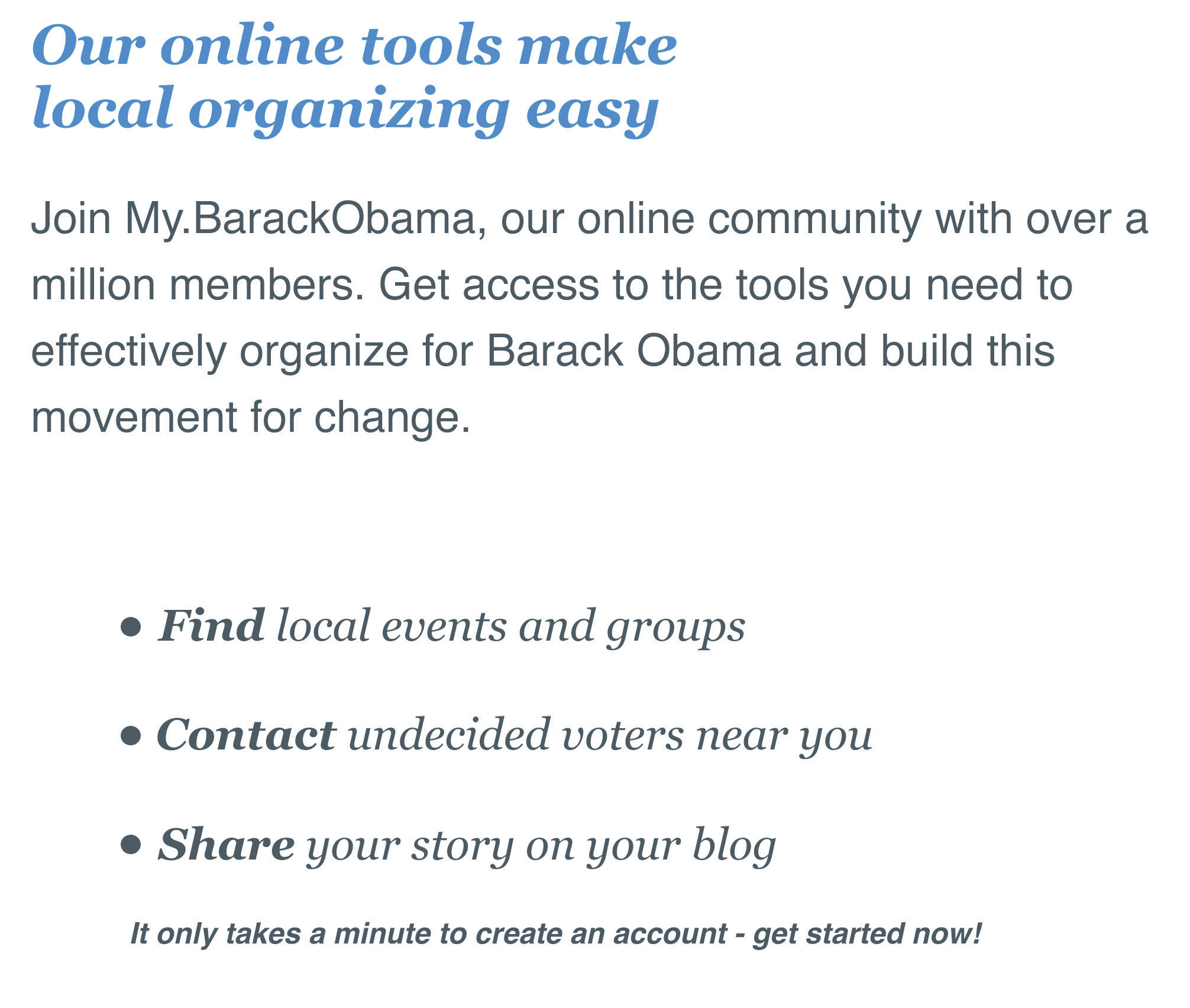
The skillset learned was to utilize and incorporate as many
online marketing activities you can participate in. The Obama campaign was highly strategized,
targeted the right demographic, and ultimately won the election.
Reflection
Throughout this session, I read about and understand the 4 P’s
of marketing and how they are changing as a result of technology, how search
engines work and the difference between organic vs. advertisements, and a vast
amount of information on PPC advertising.
Honestly, I feel a bit overwhelmed with all of the information, but that
happens at the start of every graduate class.
I was lost on some of the content covered in the first class, but
reading the book helped bring everything together. I’m really excited about the GOMC; I have
never participated in anything like that in any of my other classes. Next session will cover Web Analytics and
Conversion Optimization, I am eager to use this knowledge for Pittsburgh Center
for Creative Reuse and the GOMC.
Stokes, R. (2011). emarketing: The essential guide to digital marketing. (V 1.0 ed.). Quirk Education. Retrieved from http://catalog.flatworldknowledge.com/bookhub/reader/19

Hi Jeff,
ReplyDeleteI think you did a great job on this first blog post -- You kept it very interesting and fun to read while being succinct which I appreciate. Your opening paragraph on the challenges to the 4 P's was really informative and I agree completely that marketers need to have an online strategy that fits with their offline one. This was something I felt the book should have emphasized more, particularly for those of us with little prior marketing experience offline as well.
Your use of the Obama campaign to illustrate how a group should coordinate their online and offline presences was a great idea as well. It definitely helped me to see a strategy where you put together both of your campaigns to create a huge marketing force. I would love to see how this would work on a smaller scale and with a smaller budget, especially since most (if not all) of the groups we are working with in class do not have the resources necessary to finance huge campaigns in both arenas.
Jeff, great post! I discussed the four p's of marketing in my post as well. I would just like to propose the following question: Do you think the four P's of marketing have changed and the originals are irrelevant? Or is it more of a shift to apply to new marketing methods? I believe that the four p's are still just as applicable today in marketing even with the newer beliefs and influence of e-marketing.
ReplyDeleteThanks Jeff - it would be great if you could share some of your questions with us!
ReplyDelete