Wednesday, March 26, 2014

BUS572 - Blog #5

The Google e-learnings contained a vast amount of information.  I found it helpful to have the questions at the bottom of each section, and the ability to check your answers.  This provided better preparation for the certification.  I still have not had the chance to use Google Analytics yet, still waiting for the opportunity.  It would be helpful to apply this knowledge; however I think I will retain most of it. 


Our group has had a difficult time with the Google Online Marketing Challenge.  There are a lot of “hoops” that you need to jump through in order to actually begin.  Just a few minutes ago, I think I finally completed all steps and the account is active.  I’m not 100% sure, because I have thought that before just to find out there are additional steps that need to be completed.  

Wednesday, March 5, 2014

BUS572 - Blog #4

Concept #1 – Cookies
I always thought cookies were something you ate for a snack or desert, but this week taught me otherwise.  A cookie is a small piece of data sent from a website that is stored in a user’s web browser.  Every time you visit a website, the browser sends data to the website regarding previous activity on that specific website.  Cookies are used as session management to maintain relevant data during a set period, for personalization, and tracking.  I decided to do a bit more research about cookies and discovered there is a cookie called a zombie cookie; of course, I had to read about this.  These cookies are able to recreate themselves even after a user deletes them, the name makes sense.  You can read more about zombie cookies on Techopedia.  How do you feel about zombie cookies recreating after you delete them? 

Concept #2 – Google Display Network
The Google Display Network is a collection of partner networks that show AdWords ads.  This display network reaches 83% of internet users all over.  By utilizing this, you can reach new customers, select where your ads appear, and engage users with appealing ad formats.  Text ads (which will be utilized in the GOMC), image ads, rich media ads, and video ads can all be exploited in the display network to Google's trusted partners.  When Sarah from Luna Metrics came, I remember her advising only to select the Google Display Network, because of the uncertainty of the others.  Are there any other competitors that are reducing Google’s market share when it comes to their display network, or are they continually expanding?
 
Skillset – Google Analytics
A crucial skillset gained throughout this session is utilizing Google Analytics.  Not only will my group for Global Marketing be using Google Analytics for the GOMC, but I informed one of my business associates about Google Analytics, and it blew his mind!  He has since turned it on, and I am looking forward to reviewing the results with him.  This tool can be used to track just about anything you would want to know about users on your website.  I can’t wait to get my hands dirty with Google Analytics. 

Conclusion
Throughout this week, I learned a variety of topics.  The Ghose reading was difficult for me; it had an enormous focus on equations.  These equations were confusing, so I tried to focus on the point they were trying to illustrate in the equations.  Focusing on this helped me to understand some of the equations, even though they were way over my head. 


Sunday, February 16, 2014

BUS572 - Blog #3

Concept 1 – SEO Evolution
Search engine optimization (SEO) involves the visibility of your webpage on the search engine results page (SERP) in the organic search results.  There are four emerging trends in SEO; localization, personalized search, usage data, and real-time search.  Localization involves reaching users based on their language and geographic location.  Personalized search can be broken down to implicit and explicit.  Implicit personalized search gathers users’ behavior and predict their interests on SERP.  Explicit personalized search utilizes information sent directly to search engines including location, age, gender, and language.  Search engines interpret how users react to websites in relation to their search query.  If all users that search a specific keyword and enter the website and immediately leave, the website is probably not relevant to that search.  Services such as Google AdWords, AdSense, Analytics, Web Site Optimizer, Checkout, and Toolbar can help marketers provide relevant information specific to the searched keywords.  Real-time search incorporates real-time information such as social media, blogging, and news websites in the SERP.  These emerging trends help marketers reach users when they are searching for a product or service that is relevant to their organization.  There are unethical practices to increase the visibility of a website; this is referred to as black-hat SEO.  Google has outlined guidelines in Webmaster Central.  How often does black-hat SEO occur?  Are there any consequences other than the search engine not indexing the website anymore? 

Concept 2 – Things to consider when choosing a keyword
When Tim James from Google presented to our class, he said to think like a customer when selecting keywords.  What search keywords would a consumers search when trying to find your product or service?  The Google Keyword Planner is an excellent tool to start with for keyword research.  Introducing Keyword Planner: combining the Keyword Tool and TrafficEstimator into One is a great resource for using the keyword planner. 


(Source: Inside AdWords)
The keyword planner should include similar keywords, common keywords used with searched keyword, common misspellings, frequency of keywords in search queries, industry-related keywords, keywords that are sending traffic to competition, and how many other sites are targeting your keywords.  Common misspellings are important to analyze, but marketers need to analyze the quality of traffic these misspellings will send to your website.  Marketers can utilize low-volume terms at a low cost for the short term, but they should also consider the high competition keywords.  I think Tim James’ advice to think like a consumer is critical for success; start broad and make your way to a “happy medium,” don’t get too specific.  That is a grey area for me, when are your search terms too specific? 

Skillset – Links
Website links can help to increase the quality score and establish the credibility of a website.  Government websites (.gov) and university domains (.edu) carry more weight than other websites.  Webmasters can insert a “no follow” in the link to another website which means they are not assuring the content in the linked URL.  Search engines evaluate the relation of content between the linking websites and can determine if the link is manipulated, meaning it only exists for ranking purposes.  Manipulated links decrease the search engine rankings, whereas natural links increase search engine rankings.  Marketers can receive more links to their website by utilizing several different tactics:
  • Valuable content that users want to reference
  • Tools and documents can include calculators or other tools that will be helpful to user
  • Games - just make sure the games are relevant to your website
  • Software and widgets
  • Web Public Relations (WebPR)
  • Competitor analysis – What sites are linking to your competitors website?

Microsoft has outlined 10 Steps to Getting Links to your Site.  I understand that this is an ongoing process, but is there any specific timeframe that results can be expected?  How long after the tactics are followed can we expect links?  What if your website uses these tools, but still does not receive links? 

Conclusion

This section didn’t involve too much new content, most of the topics have been introduced in the past, but chapter 6 provided more detail.  Due to the past exposure of general information about A/B testing, multivariate experiments, display advertising, Google Analytics, SEO, keywords, links, and emerging trends, the concepts were easier to understand.  I’m anxious for the GOMC to start; I find it strange that there is no timeframe for this.  I’m excited for Wednesday’s class and further discussing our campaign designs.  

Monday, February 3, 2014

BUS572 - Blog #2

Concept 1 - Log-File Analysis vs. Page Tagging
Throughout this session, there were several important topics in Chapter 15, Web Analytics and Conversion Optimization.  I think understanding how web analytics gathers information on counts and ratios and the two main approaches are crucial. In log-file analysis, a log file is stored on a user’s computer recording all clicks on that specific server.  Page tagging involves sending the information to a third party server where the information is stored.  Understanding the strengths and weaknesses of each will help lead to the best decision.  Log files are in a standard format, but page tagging is proprietary to the given vendor, so if there is a switch, historical data will likely be lost.  Because each vendor has their own software for page tagging, there is more support for your organization; log files are typically managed in-house.  In page tagging, if the user’s browser does not support a specific programming language, typically JavaScript, then no information will be generated for this user.  Log files records both successful and unsuccessful requests, page tagging can only send the information if the page loads.  Given these differences, it is important to understand that if both concepts are utilized, the numbers will not be the same, however the messages conveyed within the information should be the same. 

Concept 2 - Testing
Testing can be a key tool to increase conversion rates.  There is no “cookie cutter” format that will increase sales; organizations need to try different ways of advertising their product to the consumer.  The text provides four examples, A/B split testing, multivariate testing, listening labs, and single-page heat maps.  A/B split testing measures one variable in different ways and keeps other variables constant.  This should help to provide concise information on which variable produces the best results.  Multivariate testing compares many different variables to help determine which provides the best conversion rate.  When doing this, it is important to be objective driven and not get hung up on the different variations.  Listening labs occur when a user is asked to navigate the website or complete a task and think out loud to provide insight on the usability.  A single-page heat map illustrates where users are clicking on a website, even if they are not selecting a link.  Ultimately, the goal of testing is to increase conversion rates; to be successful, analysis and modification must be an ongoing process. 

Skillset - Developing Keywords and AdGroups
In the reading, I was able to understand the concepts that were presented, however the skill developed was from Google, Using Tools to Build Keywords & AdGroups.  There are 4 steps that will guide your toward success when developing ad groups.
  • Expand: When starting, it is typically beneficial to begin with broad keywords, then work toward the long tailed keywords.  The “Keyword Planner” in Google AdWords can help to find other relevant keywords, including negative keywords.  The Traffic Estimator and Google trends can provide estimates for expected volumes and price history. 
  • Refine: After generating many keywords, you want to select only those that will directly reach your customer. 
  • Target: This entails how you can reach users when they are searching for your service.  Keyword match types are defined as broad, modified broad, phrase, and exact match types.  More information can be found Using Keyword Matching.  
  • Group: The final step is to identify similar keywords and place them in the same AdGroup.  The image below presents an example running 2 campaigns each with 2 AdGroups. 


Conclusion
This session will help the class to prepare for the GOMC.  In class, listening to Sarah Peduzzi from Luna Metrics, I was overwhelmed with all of the information she provided.  Everything started to come together when I was in Google Analytics exploring what it has to offer.  Being a hands-on learner, it would have been beneficial for the class to bring their computer and sit with their group and follow along with what she was doing.  


Stokes, R. (2011). emarketing: The essential guide to digital marketing. (V 1.0 ed.). Quirk Education. Retrieved from http://catalog.flatworldknowledge.com/bookhub/reader/15

Tuesday, January 21, 2014

BUS572 - Blog #1

Blog #1

During the first session, we read about eMarketing Strategies, Search Engine Marketing, and Pay-Per-Click (PPC) Advertising.   

Concept 1 - Challenges to the 4 P's
The increasing transition toward the internet has driven change from the traditional 4 P’s of marketing to new theories by Seth Godin and Idris Mootee.  The traditional 4 P’s of marketing were developed by E J McCarthy; products and services, price, placement or distribution, and promotion.  Mootee and Godin have embraced customer-centric marketing; understanding consumer needs, and from there carrying out their business objectives.  Seth Godin believes marketing is formed from 5 elements; 1) data is the information gathered about the consumer, 2) stories are everything consumers say and do, 3) products, at https://www.openforum.com/articles/seth-godins-9-tips-on-creating-a-remarkable-product/, Godin provides 9 tips for creating a remarkable product using a consumer-centric approach, 4) interactions are how marketers begin a relationship, and 5) connection is the relationship itself.  Idris Mootee proposed the new P’s of Marketing; personalization, participation, peer-to-peer communities, and predictive modeling.  These challenges are a result of the internet and eMarketing strategies.  It is important for marketers to recognize transition toward eMarketing, but most organizations need to have an offline marketing strategy that is aligned with their online strategy. 

Concept 2 - PPC Advertising

Another crucial concept that will be utilized in the Google Online Marketing Challenge (GOMC) is PPC discussed in Chapter 7.  In a PPC advertising campaign, advertisers can define keywords that when searched that will appear with other advertisements.  Selecting these AdWords through Google can fall into a broad match, phrase match, exact match, negative match, or any combination.  When monitoring results, click-through rates (CTR) needs to be monitored along with conversion rates.  In my opinion, the most important task in a PPC campaign is to constantly monitor the results and be flexible.  After all, every marketing plan has key goals and is trying to achieve the highest return on investment (ROI); this is ultimately how you measure your success and make changes where necessary.  PPC advertising can increase traffic to your website and is easily traced through real time data; but there are flaws in the system.  Advertisers need to beware of 1) click fraud, when competitors understand that each click need to be paid for, 2) bidding war, when an organization focuses on specific keywords, disregarding the ROI, and 3) the time required to analyze and modify strategy. 

Skill - Overall Utilization of eMarketing
The most important skillset developed comes from the chapter 19 case study on Barack Obama’s strategic use of the internet.  This case incorporates so many different components of eMarketing.  The strategy illustrated is brilliant!  The younger generation has been the hardest group to reach in the past by any presidential candidate; because of this, Barack Obama made the younger generate his target market.  How do you reach the younger generation?  Social media!  The Obama campaign utilized Facebook, Twitter, YouTube, Flickr, and www.my.barackobama.com.  This website utilized both Godin and Mootee’s marketing elements through the links below. 
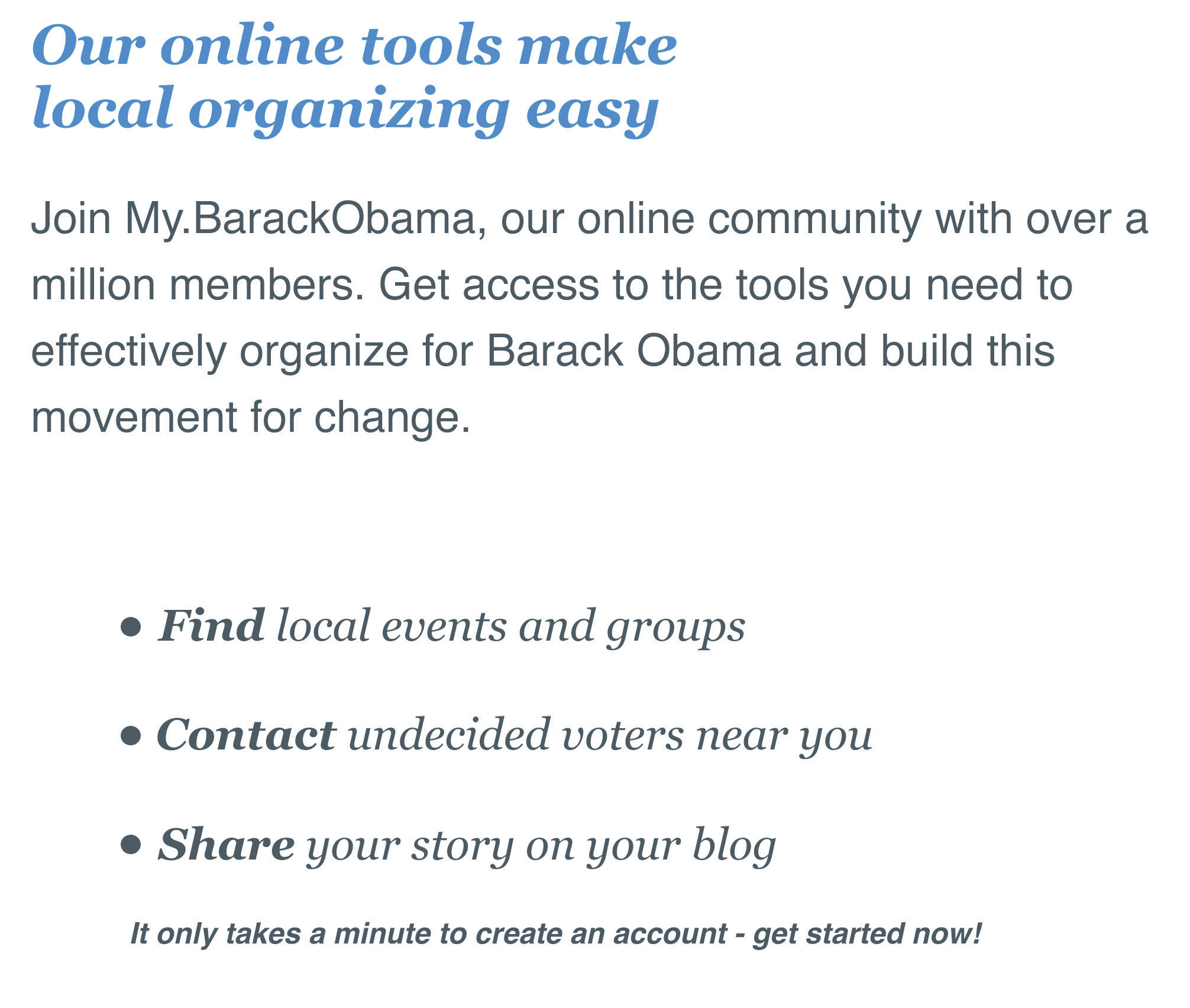


The skillset learned was to utilize and incorporate as many online marketing activities you can participate in.  The Obama campaign was highly strategized, targeted the right demographic, and ultimately won the election.  

Reflection
Throughout this session, I read about and understand the 4 P’s of marketing and how they are changing as a result of technology, how search engines work and the difference between organic vs. advertisements, and a vast amount of information on PPC advertising.  Honestly, I feel a bit overwhelmed with all of the information, but that happens at the start of every graduate class.  I was lost on some of the content covered in the first class, but reading the book helped bring everything together.  I’m really excited about the GOMC; I have never participated in anything like that in any of my other classes.  Next session will cover Web Analytics and Conversion Optimization, I am eager to use this knowledge for Pittsburgh Center for Creative Reuse and the GOMC.  

Stokes, R. (2011). emarketing: The essential guide to digital marketing. (V 1.0 ed.). Quirk Education. Retrieved from http://catalog.flatworldknowledge.com/bookhub/reader/19